
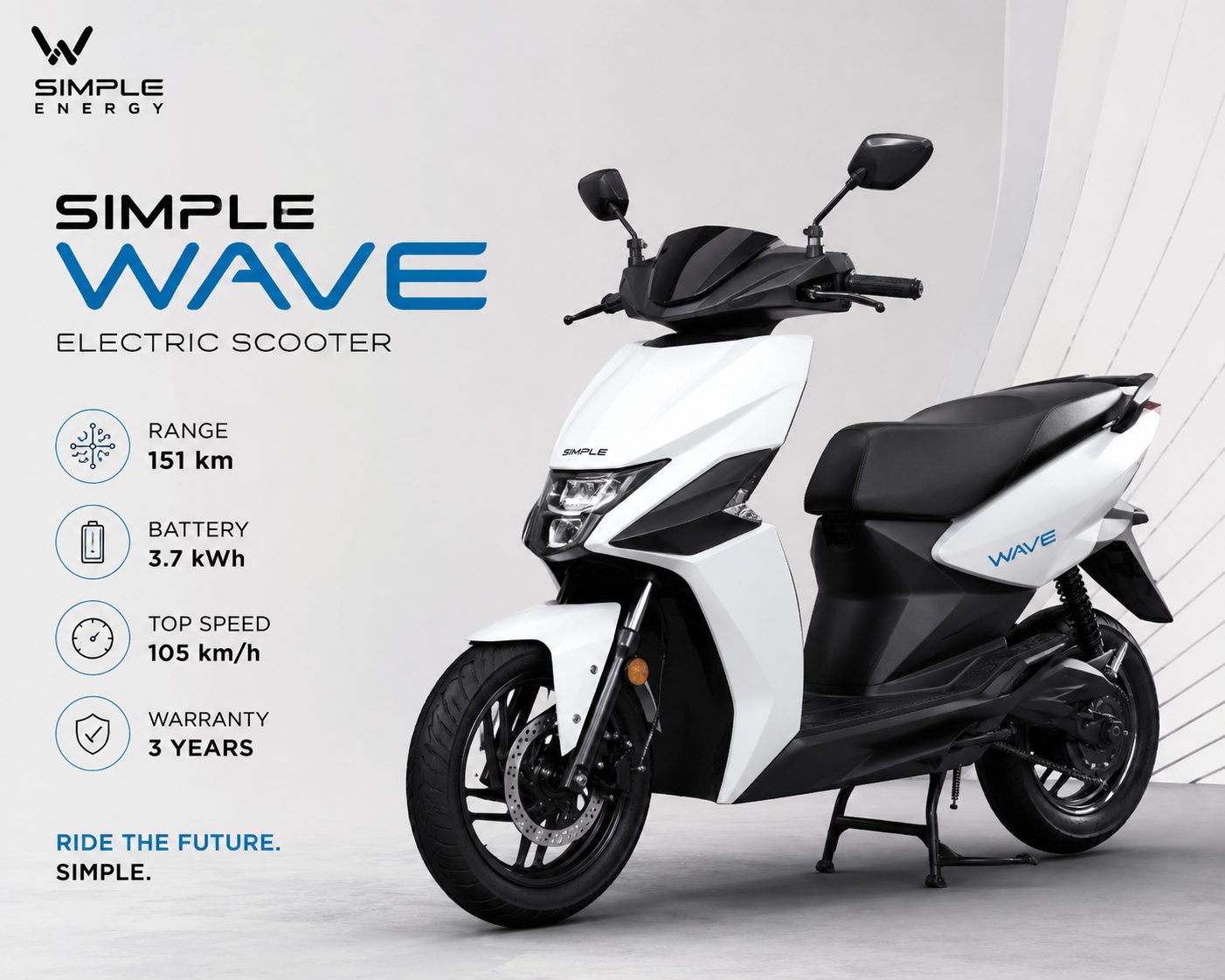
Simple Wave Electric Scooter: Honest 2026 Review
The simple wave electric scooter has officially arrived in India, giving Simple Energy a more practical option for everyday family riding. The company launched the Wave on September 2, 2026, with an introductory starting price of ₹1,09,999 and deliveries scheduled to begin from September 25.
The biggest story isn’t outright performance. It’s practicality. The simple wave electric scooter offers up to 70 litres of storage, several battery choices, and a family-focused design that is quite different from the sharper Simple One. Simple Energy’s official product page confirms three variants: Wave S, Wave and Wave+.
There is one catch worth knowing before you get excited about the headline numbers. The ₹1,09,999 figure is the introductory starting price, while complete pricing for the higher configurations has not yet been announced.
In this article:
- Simple Wave price and launch details
- Battery, range and performance
- Storage and family practicality
- Features and charging
- Simple Wave vs Ather Rizta
- Who should buy it
- What remains unconfirmed
- Frequently asked questions
Simple Wave Electric Scooter Price and Variants
The simple wave electric scooter is positioned as Simple Energy’s family-oriented model, below its more performance-focused One range. The lineup contains three main variants and six configurations, covering different battery sizes and equipment levels.
The announced introductory price starts at ₹1,09,999. That’s the figure to watch, but don’t treat it as the price of every version.
The lineup broadly looks like this:
| Variant | Battery | Claimed IDC range | Top speed |
|---|---|---|---|
| Wave S | 2.2 kWh | 110 km | 75 km/h |
| Wave S | 2.7 kWh | 132 km | 75 km/h |
| Wave | 3.7 kWh | 171 km | 90 km/h |
| Wave+ | 5 kWh | 243 km | 90 km/h |
The official Simple Energy page lists 243 km, 171 km and 132 km as the headline ranges for the three main versions, while launch coverage provides the additional 110 km configuration.
For related reading, see our Simple One electric scooter guide — ADD YOUR URL.
Simple Wave Electric Scooter Range and Battery
Range is where the simple wave electric scooter becomes more interesting than its starting price suggests. The top Wave+ uses a 5 kWh battery and has a claimed IDC range of up to 243 km.
Lower versions use smaller batteries, making the range more appropriate for shorter daily commutes. The 3.7 kWh model claims 171 km, while the 2.7 kWh and 2.2 kWh versions claim 132 km and 110 km respectively.
Those are IDC figures, not a promise that you’ll travel exactly that distance in normal riding. Traffic, speed, passenger weight, road conditions and riding mode can all change real-world range.
The battery choices are actually one of the Wave’s strengths. Instead of forcing every buyer into the most expensive configuration, Simple Energy is giving buyers a way to match battery size with daily usage.
If your commute is 20 to 30 km a day, paying extra for the biggest battery may not make financial sense. A higher-capacity version makes more sense if you regularly travel longer distances or want fewer charging stops.
Simple Wave Electric Scooter Storage Is the Big Advantage
The simple wave electric scooter has been designed around a problem that conventional performance scooters sometimes overlook: carrying stuff.
Simple Energy claims up to 70 litres of total storage. That includes up to 63 litres under the seat, a 3-litre glovebox and a 4-litre auxiliary compartment called the Pill.
That matters for family use.
You can think about grocery bags, rain gear, charging equipment and everyday belongings rather than just helmets. The flat floorboard also supports the scooter’s practical positioning.
This is one area where the Wave has a clear argument against the performance-first scooters in Simple Energy’s own range. The Simple One focuses more heavily on speed and performance, while the Wave makes carrying people and belongings part of the design.
The company also lists a 775 mm seat height, which puts the Wave in a familiar family-scooter territory.
For related reading, see our Simple OneS electric scooter guide — ADD YOUR URL.
Motor, Speed and Everyday Performance
The simple wave electric scooter isn’t slow simply because it’s designed for families.
The Wave and Wave+ use a 6.4 kW motor, while the smallest 2.2 kWh configuration uses a 4.5 kW motor. The Wave+ has a claimed top speed of 90 km/h and a 0-40 km/h time of 3.3 seconds.
The smaller Wave S versions are rated at 75 km/h.
That gives buyers a useful distinction. The base version is mainly about affordable urban transport, while the Wave+ offers enough performance for riders who regularly use faster city roads.
Simple Energy has also moved the Wave away from the aggressive styling of the One. Its more conventional shape should make sense to buyers who want an electric scooter that looks familiar rather than sporty.
That may actually help the Wave reach a wider audience.
Features and Charging
The simple wave electric scooter gets a mixture of practical and connected features depending on the configuration.
Higher versions can include a 7-inch TFT display, while other configurations use a simpler EBN display. Connected functions include features such as navigation, tracking and call or music controls on applicable versions.
The Wave also includes features aimed at everyday riding, including hill hold, reverse functionality and regenerative braking on applicable trims. The higher-end versions get more of the technology package.
Charging is another area where configuration matters. Launch information says fast charging can take the Wave+ from 0 to 80 percent in about 2 hours 15 minutes, while the company also offers a 750W portable charger.
That makes home charging particularly relevant. If you have a predictable daily commute and can charge overnight, you may not need a public charging network very often.
Simple Energy also provides a charging-station network, although buyers should check the current coverage around their regular routes before making a purchase.
Simple Wave vs Ather Rizta
The closest alternative by concept is the Ather Rizta. Both are family-focused electric scooters, but their strengths aren’t identical.
Current comparison data puts the base Ather Rizta at about ₹1.11 lakh, compared with the Wave’s ₹1.10 lakh starting figure. The Rizta has a claimed 123 km range in the compared base configuration, while the Wave S claims 110 km.
Storage changes the picture dramatically. The Rizta offers 34 litres of under-seat storage, while the simple wave electric scooter claims up to 70 litres of total storage across its compartments.
So the choice isn’t simply about which scooter has the bigger range number.
| Factor | Simple Wave | Ather Rizta |
|---|---|---|
| Starting price | ₹1,09,999* | About ₹1.11 lakh* |
| Maximum claimed range | Up to 243 km | 123 km in compared base version |
| Storage | Up to 70 litres | 34 litres under seat |
| Family focus | Strong | Strong |
| Best argument | Practicality and storage | Established family-EV proposition |
*The Wave’s announced starting figure is introductory, and higher-variant pricing was not announced at launch.
The Ather may make more sense if you value its established ecosystem and don’t need enormous storage. The Wave looks more compelling if carrying capacity is high on your list.
Is the Simple Wave Electric Scooter Worth Buying?
The simple wave electric scooter looks most convincing for urban households that want practicality first.
It should suit you if:
- You want a family-oriented electric scooter.
- You regularly carry shopping or bags.
- You value storage more than sporty styling.
- Your daily travel is predictable.
- You want several battery choices instead of one expensive configuration.
- You prefer a conventional scooter shape.
It may not be the right choice if:
- You want aggressive acceleration above everything else.
- You frequently ride long intercity distances.
- You need the largest battery but cannot justify its eventual price.
- Local Simple Energy service coverage is inconvenient.
- You want a mature ownership record for this exact model.
That last point deserves attention. The Wave has only just launched, so long-term reliability, battery ageing and real-world ownership costs for this specific scooter still need time to establish themselves.
That’s not a criticism. It’s simply what happens with a new model.
For a broader electric scooter buying guide, add your internal article link here — ADD YOUR URL.
What Is Still Unknown?
The simple wave electric scooter has a strong specification sheet, but several buying questions need more time.
The most obvious issue is pricing. Simple Energy has announced the starting introductory figure, but full prices for the higher configurations were not announced with the launch.
Real-world range also remains less certain than the IDC figures. The 243 km headline is useful for comparing the battery configurations, but everyday riding will produce different results.
Service experience is another variable. A new family scooter needs to prove that its service network can support a much larger customer base.
So the smart approach is simple: compare the exact variant you want, check the nearest service centre, and take a proper test ride before paying.
Frequently Asked Questions
What is the starting price of the Simple Wave electric scooter?
The simple wave electric scooter has an announced introductory starting price of ₹1,09,999. The company has not yet announced complete pricing for all higher configurations.
What is the maximum range of the Simple Wave?
The Wave+ has a claimed IDC range of up to 243 km. Smaller versions claim between 110 km and 171 km depending on battery capacity.
How much storage does the Simple Wave have?
The simple wave electric scooter offers up to 70 litres of combined storage. This includes the under-seat area and additional compartments.
When do Simple Wave deliveries begin?
Deliveries are scheduled to begin from September 25, 2026, according to launch coverage.
Is the Simple Wave better than the Ather Rizta?
Neither is automatically better. The Wave has a major storage advantage and offers a higher claimed maximum range, while the Rizta remains an established family-scooter alternative with its own ecosystem and feature set.
Final Thoughts
The simple wave electric scooter is an important change in direction for Simple Energy. Instead of competing mainly on performance, the company is targeting the everyday family rider with storage, comfort and multiple battery options.
Its strongest selling point may actually be the least glamorous one: practicality. A claimed 70 litres of storage can make a bigger difference to daily life than another headline performance figure.
Still, don’t buy the Wave purely because of the 243 km range claim. Wait for the exact variant pricing, consider your actual daily distance, check local service support and judge the scooter on a test ride.
The simple wave electric scooter has a promising starting package. Its real test will be ownership.
Key Takeaways
- The Wave’s biggest advantage is practical family usability rather than outright performance.
- The large storage capacity gives it a meaningful edge over several similarly priced rivals.
- Multiple battery options make the range of the lineup more flexible for different commuters.
- The biggest buying uncertainty is not the headline specification, but final pricing and long-term ownership experience.
- For practical city use, the Wave looks more compelling than its performance-focused sibling, provided local support works for you.
Simple Energy — official Simple Wave page
Simple Energy warranty information
Also Read : MG Windsor EV Redefines Daily Driving